To reach or stay at a healthy weight,
how much you eat is just as important as what you eat. Do you know how
much food is enough for you? Do you understand the difference between a
portion and a serving? The information below explains portions and
servings, and provides tips to help you eat just enough for you.
To reach or stay at a healthy weight, how much you eat is just as important as what you eat.
What is the difference between a portion and a serving?
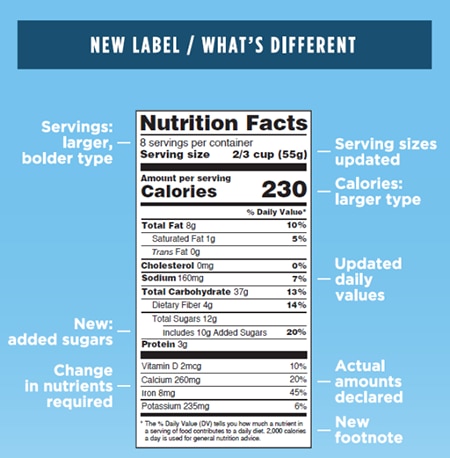
A portion is how much food you choose to eat at one time, whether in a restaurant, from a package, or at home. A serving, or serving size, is the amount of food listed on a product's Nutrition Facts, or food label (see Figure 1 below).
Different products have different serving sizes, which could be
measured in cups, ounces, grams, pieces, slices, or numbers—such as
three crackers. A serving size on a food label may be more or less than
the amount you should eat, depending on your age, weight, whether you
are male or female, and how active you are. Depending on how much you
choose to eat, your portion size may or may not match the serving size. Figure 1. Updated Nutrition Facts Label
Source: U.S. Food and Drug Administration
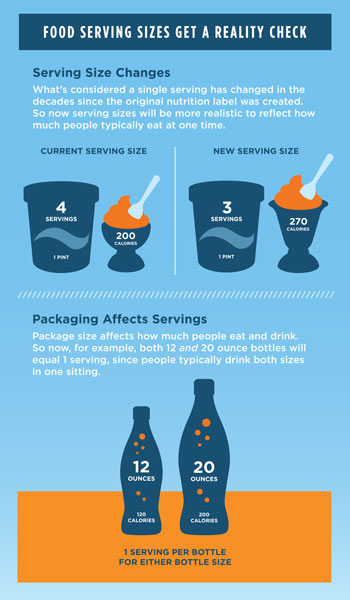
As a result of updates to the Nutrition Facts label
in May 2016, some serving sizes on food labels may be larger or smaller
than they had been before (see Figure 2 below). For instance, a serving
size of ice cream is now 2/3 cup, instead of 1/2 cup. A serving size of
yogurt is 6 ounces rather than 8 ounces. The U.S. Food and Drug
Administration (FDA) changed some food and beverage serving sizes so
that labels more closely match how much people actually eat and drink. Figure 2. FDA Serving Size Changes
Go back to the updated food label in Figure 1 above. To see how many
servings a container has, you would check “servings per container”
listed at the top of the label above “Serving size.” The serving size is
2/3 cup, but the container has eight servings. If you eat two servings,
or 1 1/3 cups, you need to double the number of calories
and nutrients listed on the food label to know how much you are really
getting. For example, if you eat two servings of this product, you are
taking in 460 calories:
230 calories per serving x two servings eaten = 460 calories
How much should I eat?
How many calories you need each day to lose weight or maintain your weight depends on your age, weight, metabolism,
whether you are male or female, how active you are, and other factors.
For example, a 150-pound woman who burns a lot of calories through
intense physical activity, such as fast running, several times a week
will need more calories than a woman about the same size who only goes
for a short walk once a week. The Dietary Guidelines for Americans 2015-2020 can give you an idea of how many calories you may need each day based on your age, sex, and physical activity level. Use the Body Weight Planner tool to make your own calorie and physical activity plans to help you reach and maintain your goal weight.
How many calories you need each day depends on your age, weight, metabolism, sex, and physical activity level.
How can the Nutrition Facts food label help me?
The FDA food label is printed on most packaged foods. The food label
is a quick way to find the amount of calories and nutrients in a certain
amount of food. For example, reading food labels tells you how many
calories and how much fat, protein, sodium,
and other ingredients are in one food serving. Many packaged foods
contain more than a single serving. The updated food label lists the
number of calories in one serving size in larger print than before so it
is easier to see.
Other Helpful Facts on the Food Label
The food label has other useful information about what is included in
one food serving. For example, one serving on the food label in Figure 1
above has 1 gram of saturated fat and 0 grams of trans fat, a type of fat that is unhealthy for your heart.
The updated food label also includes information about “added
sugars.” Added sugars include table sugar, or sucrose, including beet
and cane sugars; corn syrup; honey; malt syrup; and other sweeteners,
such as fructose or glucose,
that have been added to food and beverages. Fruit and milk contain
naturally-occurring sugars and are not included in the label as added
sugars. The Dietary Guidelines for Americans 2015-2020 calls for
consuming less than 10 percent of calories daily from added sugars.
Because Americans do not always get enough vitamin D and potassium,
the updated food label includes serving information for both of these
nutrients. Since a lack of vitamin A and vitamin C in the general
population is rare, these nutrients are no longer included on the food
label. However, food makers may include them if they choose. Most food
makers will have to start using the new food label by July 26, 2018.
Figure 3 below compares the updated food label with the original label. Figure 3. Side-by-Side Comparison of Original and New Nutrition Facts Label http://serranokrogsgaard12.iktogo.com/post/nutritional-supplement-for-erectile-dysfunction--what-are-the-very-idealhttps://serranoweeks28.tumblr.com/post/182623516171/nutritional-supplement-for-impotence-problems https://krogsgaardgrady33.bloggerpr.net/2019/02/07/nutritional-supplement-for-erectile-dysfunction-what-one-is-the-very-ideal/

Комментариев нет:
Отправить комментарий